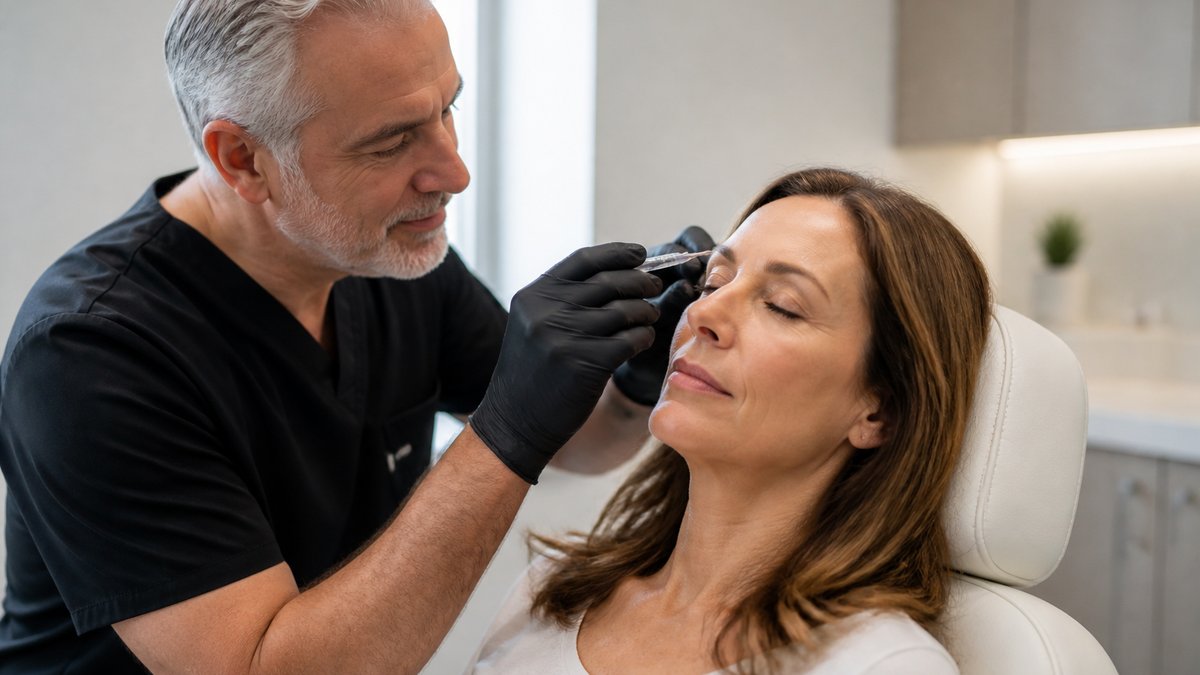
Botox uses a purified neurotoxin to relax targeted muscles, which softens expression lines that form with repeated movement. Treatment focuses on specific areas of the face and neck where muscles pull the skin into creases. Each region responds differently, so providers map injection points based on muscle strength, depth, and motion patterns. Here are some of the main treatment areas:
Forehead Furrows
Horizontal forehead furrows develop as the frontalis muscle repeatedly lifts the brows, and the skin folds along the same lines. When a clinician injects Botox into this muscle, it relaxes enough to reduce the depth of these creases. The forehead surface typically looks more uniform. The dosage varies because some people recruit the frontalis strongly while others use it less.
Planning forehead treatment typically starts with observing natural expressions. Lines appear more clearly when the patient raises the brows. The injector maps a grid across the muscle, and they place small injections at several points rather than one concentrated spot. If injections sit too low, they may affect brow position.
Lip Lines
Vertical lip lines form during speaking, sipping, or pursing, and repeated action gradually imprints the skin. Small doses of Botox weaken selected fibers of this muscle, so the mouth still functions while the lines around it appear less pronounced. Treatment in this region typically uses conservative quantities, because the injector aims to preserve articulation and straw use. Keep these factors in mind:
- Providers target tiny points along the upper and sometimes lower lip border.
- Patients may pair these injections with fillers, and this addresses motion and volume loss.
- Results tend to appear within days, and they typically peak within a couple of weeks.
- Follow-up visits help refine dosing if speech or lip function feels different than desired.
Crow’s Feet
Crow’s feet radiate from the outer corners of the eyes, and they reflect years of smiling, squinting, and sun exposure. When Botox relaxes this muscle segment, the fan of lines often softens, and the eye area may look smoother in both rest and expression. Since the skin around the eyes is thin, precise placement and dosing play a large role in natural-looking outcomes.
The injector typically asks the patient to smile, and this highlights the full pattern of crow’s feet before treatment. They then place several small injections in a curved line outside the orbital rim, and they avoid injecting too close to the eyelid margin, which helps protect eyelid function. Follow-up photographs support dose adjustments.
Crow’s feet treatment can be paired with brow injections, and this combination addresses multiple expression patterns at once. When the lateral eye area relaxes, it sometimes reveals volume loss at the cheek junction. Patients who spend time outdoors benefit from consistent sun protection. A structured maintenance plan helps keep results steady while respecting the natural dynamics of each face.
Neck Bands
Vertical neck bands arise from the platysma muscle, which runs from the jawline down the front of the neck and pulls the skin into cords. Targeted Botox injections into these bands reduce their activity. The neck surface may appear smoother when the muscle contracts less. Treatment typically follows the visible lines from the chin toward the collar area, and the injector spaces small doses along each band.
Schedule Botox Sessions Near You
Patients who want focused treatment benefit from a structured consultation with a qualified injector. A medical evaluation reviews muscle patterns, skin quality, and previous procedures, and a treatment plan outlines dosing, timing, and maintenance. When sessions follow an individualized roadmap, results tend to look more tailored, and adjustments over time refine both symmetry and expression.